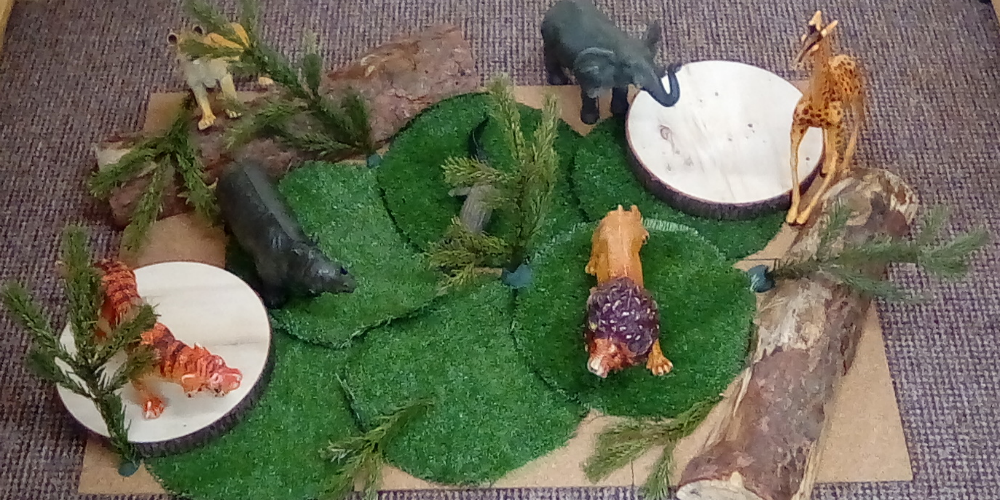
Fundamental Principles of Reggio Emilia inspired nurseries
1. Children are capable of constructing their own learning and are driven by their interests to understand and know more.
2. Children form an understanding of themselves and their place in the world through their interactions with others where. Children search out knowledge through their own investigations.
3. Communication is a process, a way of discovering things, asking questions, using language as play. Playing with sounds and rhythm and rhyme; delighting in the process of communicating. Children are encouraged to use language to investigate and explore, to reflect on their experiences. They are listened to with respect, believing that their questions and observations are an opportunity to learn and search together. It is a process; a continual process. It is a collaborative process rather than the child asking a question and the adult offering the answers, the search is undertaken together.
4. The environment is recognized for its potential to inspire children. An environment filled with natural light, order and beauty. Open spaces free from clutter, where every material is considered for its purpose, every corner is ever-evolving to encourage children to delve deeper and deeper into their interests. Space encourages collaboration, communication, and exploration. Space respects children as capable by providing them with authentic materials & tools. Space is cared for by the children and the adults.
5. Our role as adults is to observe children, listen to their questions and their stories, find what interests them and then provide them with opportunities to explore these interests further. The Reggio Emilia Approach takes a child-led project approach. The projects aren’t planned in advance, they emerge based on the child’s interests.
6. In Reggio and Reggio-inspired settings that there is an emphasis on carefully displaying and documenting children’s thoughts and progression of thinking; making their thoughts visible in many different ways: photographs, transcripts of children’s thoughts and explanations, visual representations (drawings, sculptures etc.), all designed to show the child’s learning process.
7. This is probably the most well-known aspect of the Reggio Emilia Approach. The belief that children use many different ways to show their understanding and express their thoughts and creativity.
A hundred different ways of thinking, of discovering, of learning. Through drawing and sculpting, through dance and movement, through painting and pretend play, through modeling and music, and that each one of these Hundred Languages must be valued and nurtured.
These languages, or ways of learning, are all a part of the child’s learning and play they are not separated.
The Reggio Emilia Approach emphasizes hands-on discovery learning that allows the child to use all their senses and all their languages to learn.
.